
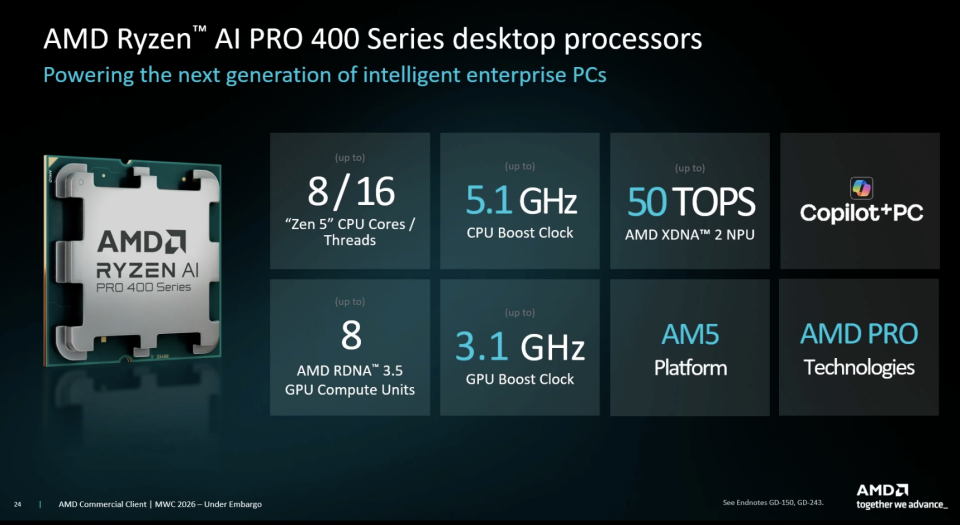

The new AMD Ryzen AI desktop processors are now available. For the first time, business workstations can have dedicated neural processing units (NPUs). These chips were announced at MWC 2026 and are meant to power Microsoft’s Copilot+ features locally. They will give businesses a huge boost in AI performance and efficiency.
AMD Ryzen AI desktop processors: Bringing NPUs to the Office
At Mobile World Congress (MWC) 2026 in Barcelona, AMD unveiled a groundbreaking update to its commercial lineup: the AMD Ryzen AI desktop processors, specifically the Ryzen AI Pro 400 Series.
For the first time, AMD is bringing its powerful XDNA 2 NPU—previously reserved for laptops—to desktop PCs. This move directly targets businesses looking to leverage generative AI applications, which are tools that use artificial intelligence to create content, like Microsoft Copilot+, without relying entirely on the cloud.

According to AMD’s official announcement, the AMD Ryzen AI desktop processors are the first of their kind to support Copilot+ features on a desktop. Until now, only mobile chips with dedicated AI silicon had these advanced AI features. By putting the NPU right into the desktop CPU, AMD is making AI processing in offices faster, safer, and less power-hungry.
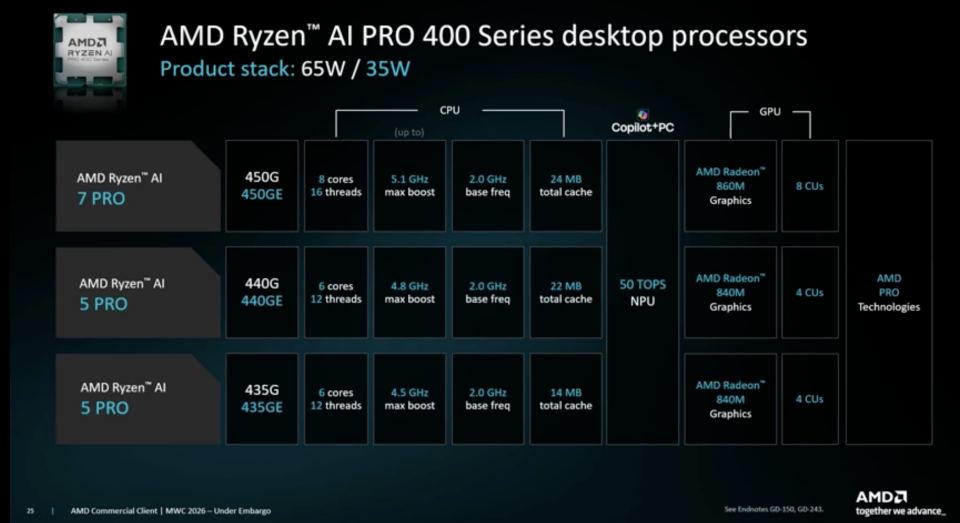
The Ryzen AI 7 Pro is the best desktop in this new line, and it has some great specs. It has 8 high-performance CPU cores that can boost speeds up to 5.1GHz and 8 RDNA 3.5 GPU cores for graphics.
These AMD Ryzen AI desktop processors also come in lower-power 35-watt versions, which is important because it lets manufacturers make small, quiet, and powerful desktop PCs for busy workspaces.
Intel and Mobile Power are competitors
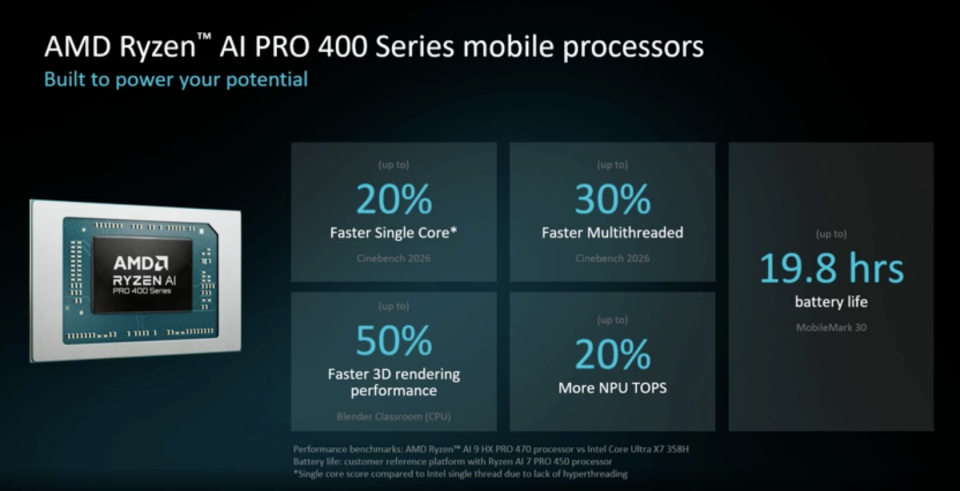
Along with the AMD Ryzen AI desktop processors, Team Red also released the Ryzen AI Pro 400 Series for mobile devices. Team Red aims to dominate the business laptop market with these chips.
They have up to 12 CPU cores and can boost speeds up to 5.2GHz. AMD says that these mobile processors can last an amazing 19.8 hours on a single charge, which is very important for business travelers.
AMD said that its top-of-the-line Ryzen AI 9 HX Pro 470 beats Intel’s “Panther Lake” Core Ultra X7 358H in processing speed, which is a direct challenge to its main rival. This performance boost also applies to AI workloads, making the AMD Ryzen AI desktop processors and their mobile counterparts the best choice for the next generation of AI PCs.
The ecosystem for AMD Ryzen AI desktop processors is growing quickly, with partners like Lenovo, HP, Dell, Asus, and Acer expected to release more than 200 commercial designs. These devices are expected to come out in the second quarter of the year, which will change the way businesses think about hardware upgrades.
Why should you switch to Ryzen AI Pro 400?
Switching to AMD Ryzen AI desktop processors gives modern businesses real benefits. Companies can lower latency and protect data privacy by moving AI processing from the cloud to the device.
Key Benefits for Users:
- Copilot+ Readiness: These are the first AMD Ryzen AI desktop processors that can run Microsoft’s advanced AI features without any extra software.
- Enhanced Security: The “Pro” label guarantees that the product has the enterprise-level security and management features that IT departments need.
- Energy Efficiency: The XDNA 2 NPU does AI tasks with a lot less power than a GPU, which lowers the office’s overall energy use.
- Compact Form Factors: The 35-watt versions of the AMD Ryzen AI desktop processors let you make smaller, sleeker PCs without losing performance.
FAQs
Q: When will you be able to buy the new AMD Ryzen AI desktop chips?
The first computers with Ryzen AI Pro 400 chips should be available in the second quarter of 2026.
Q: Do these CPUs need a separate GPU to do AI work?
No, the AMD Ryzen AI desktop processors already have an XDNA 2 NPU built in that is good at handling AI tasks, so you don’t need a separate GPU for basic AI tasks.
Q: Who is using these new chips?
HP, Dell, Lenovo, Asus, and Acer are some of the biggest OEMs working on more than 200 commercial designs that use AMD Ryzen AI desktop processors.
Conclusion: The release of the AMD Ryzen AI desktop processors marks the start of a new era in business computing, in short. AI will need to be built into computers so they can do their jobs well.