
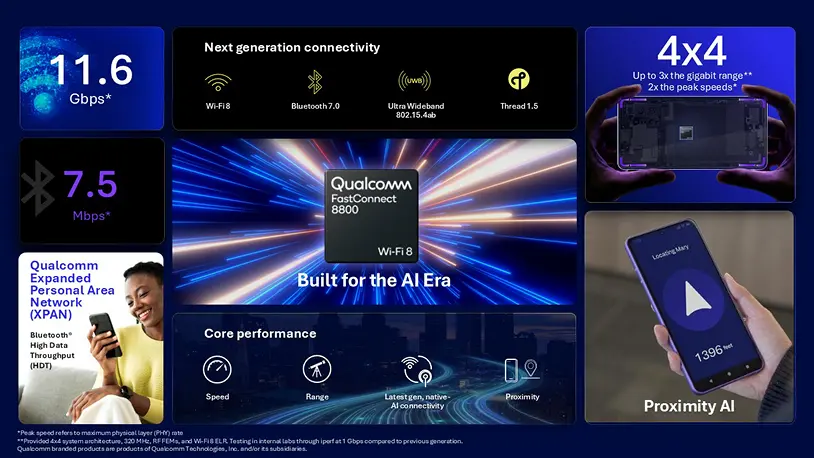

The FastConnect 8800 is the official name for the Qualcomm Wi-Fi 8 chip. This next-generation connectivity solution aims to revolutionize wireless operations. Mobile World Congress showcased this “AI-native” hardware. It promises to double internet speeds and greatly increase range, which is an important step toward building the next generation of 6G networks.
Qualcomm Wi-Fi 8 Technology: The FastConnect 8800 Explained
With its latest announcements at Mobile World Congress, Qualcomm is aggressively expanding the boundaries of connectivity. The FastConnect 8800 is the first major Qualcomm Wi-Fi 8 product, and the company is already looking ahead. Wi-Fi 7 is still new to homes. This new system-on-chip uses a 6nm process node, which keeps it efficient while delivering significant performance gains.

According to Qualcomm’s announcement, the Qualcomm Wi-Fi 8 architecture is “AI-Native.” This means the chip uses artificial intelligence to optimize connections rather than relying solely on raw power dynamically. The FastConnect 8800 features a redesigned 4×4 radio configuration. This engineering feat allows the Qualcomm Wi-Fi 8 system to double peak speeds compared to previous Wi-Fi 7 iterations. Furthermore, it enables up to 3x longer gigabit range, solving one of the most persistent issues in home networking: dead zones.
Tech enthusiasts should note that this release isn’t just a paper launch. We built the Qualcomm Wi-Fi 8 platform to handle the increasing density of connected devices in modern smart homes. By integrating AI directly into the Network Interface Card (NIC), the system can manage data traffic more intelligently than ever before.
Bluetooth improvements and 5G working together
Significant improvements in Bluetooth and cellular connectivity accompany the arrival of Qualcomm Wi-Fi 8 technology. The FastConnect 8800 supports the new Bluetooth 7.0 standard, along with Bluetooth HDT (High Data Throughput), enabling faster data transmission. This upgrade represents a massive leap over Bluetooth LE (Low Energy), raising data transfer ceilings to 7.5 Mbps—far surpassing the previous 2 Mbps cap.
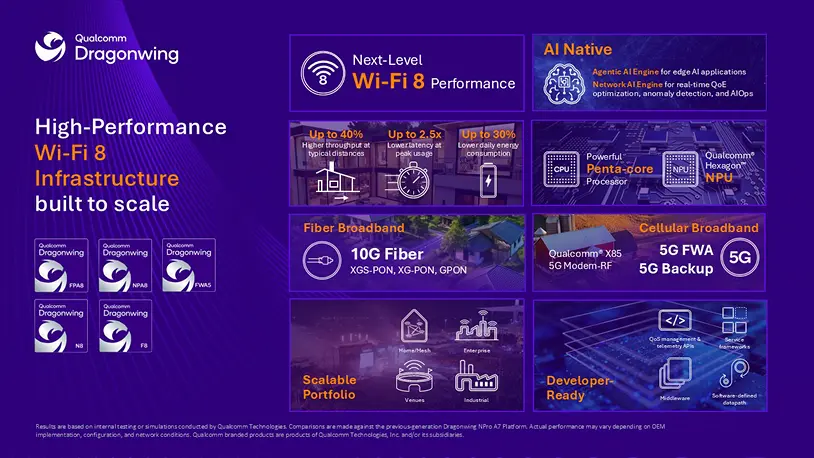
Qualcomm designed these changes to complement their new X105 5G modem. The X105 is the fifth generation of the company’s 5G AI processor. It uses agentic AI, which refers to artificial intelligence that can act autonomously to make decisions, to work with the Qualcomm Wi-Fi 8 ecosystem to improve performance across many different situations.
Users will benefit from the new connectivity suite in the following ways:
- Extended Battery Life: The new RF transceiver uses 30% less power than last year’s models, which means longer battery life.
- Higher Audio Quality: Bluetooth HDT support lets you stream high-quality audio without losing the connection.
- Seamless Handover: Qualcomm Wi-Fi 8 and advanced 5G modems work together to ensure switching between home and mobile networks is easy.
- Compact Design: The new parts use 15% less space, allowing smartphone designs to be sleeker.
From Qualcomm Wi-Fi 8 to the Future of 6G
While the Qualcomm Wi-Fi 8 chip is the immediate highlight for hardware launching in late 2026, Qualcomm is also mapping out the long-term future of global connectivity. The company has announced a “strategic coalition” with industry partners to prepare for a 6G launch beginning in 2029.
This future network is described as “AI-native,” meaning it is designed to integrate artificial intelligence capabilities, much like the Qualcomm Wi-Fi 8 FastConnect system. The goal is to create a network designed for wide-area sensing and high-performance computing.
According to reports from Android Police, Qualcomm plans to lock down 6G standards and specifications by 2028. This timeline is intended to establish a unified industry standard, leading to fully interoperable commercial 6G systems a year later.
The Qualcomm Wi-Fi 8 rollout acts as a bridge to this future. By integrating “agentic AI,” which refers to artificial intelligence systems that can act autonomously and make decisions, into current Wi-Fi and 5G products, Qualcomm is testing the very technologies that will define the 6G era. The infrastructure for these agentic devices is being built now, even though some specific use cases are still under development. As we get closer to 2029, the Qualcomm Wi-Fi 8 platform will likely set the standard for how devices communicate worldwide.
In conclusion, the Qualcomm Wi-Fi 8 chip is a big step forward in wireless technology. It ensures our devices are ready for the fast, AI-driven needs of the next 10 years.