
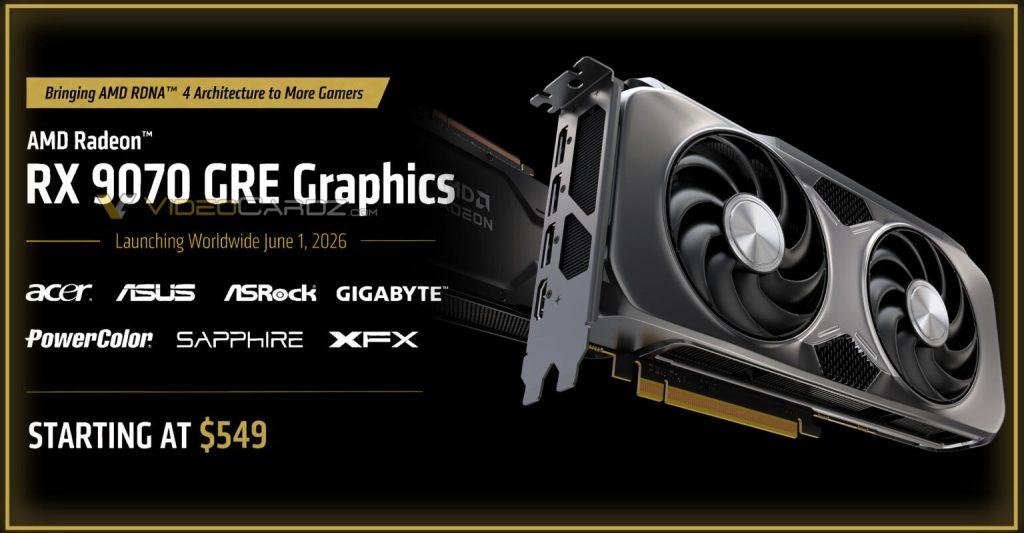
AMD has made its China-exclusive Radeon RX 9070 GRE available worldwide starting June 1, 2026. Priced at $549, this mid-range GPU targets budget-conscious gamers who want solid 1440p performance without paying high-end prices. Based on AMD’s RDNA 4 architecture, the RX 9070 GRE is a simpler version of the RX 9070 with 12GB of video memory and 48 processing units, making it a direct rival to Nvidia’s RTX 5060 Ti.
AMD Radeon RX 9070 GRE Specifications:
| Spec | Details |
|---|---|
| Price (MSRP) | $549 USD (check local price) |
| Release Date | June 1, 2026 |
| Monthly Fee | No |
| Needs Hub | No (installs directly into PC) |
| GPU Architecture | AMD RDNA 4 (Navi 48 XL) |
| Compute Units / Stream Processors | 48 CUs / 3072 SPs |
| VRAM | 12GB GDDR6 |
| Memory Bus / Bandwidth | 192-bit / 432 GB/s |
| Boost Clock | Up to 2.79 GHz |
| Game Clock | 2220 MHz |
| TDP (Power Draw) | 220W |
| Recommended PSU | 650W |
| PCIe Interface | PCIe 5.0 x16 |
| Outputs | DisplayPort 2.1a, HDMI 2.1b |
| Partner Brands | ASRock, Sapphire, ASUS, GIGABYTE, PowerColor, XFX |
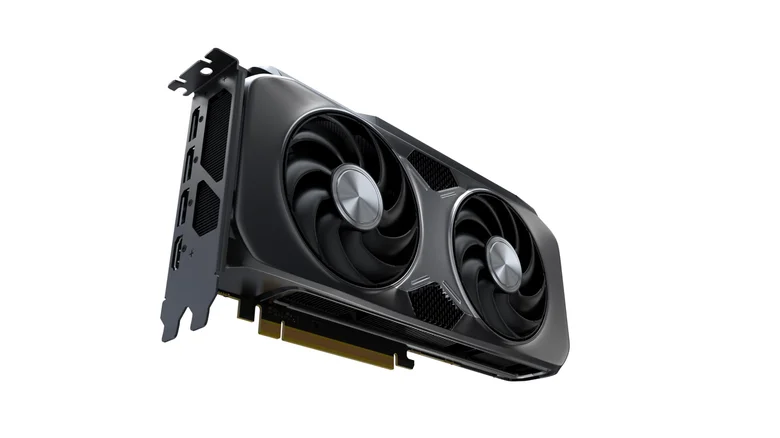
The RX 9070 GRE uses AMD’s RDNA 4 design, which focuses more on efficient operation than on high power. According to technical documents from Hot Chips 2025, RDNA 4 brings in dynamic register allocation. Unlike earlier versions that reserved memory for the toughest cases, this new model returns registers when the task is complete. This means the card stays cooler and works better during long gaming sessions.
Performance and Reliability of AMD Radeon RX 9070 GRE
GadgetOnHand hasn’t lab-tested the global retail version of the 9070 GRE yet. However, based on my 5+ years of testing mid-range GPUs, here is what you should watch for before clicking “buy”:
- The 12GB VRAM Ceiling: Modern gaming at 1440p is increasingly memory-hungry. With a 192-bit connection and 12GB of video memory, this card is in a tricky position. While it runs current games easily, games released in late 2026 and 2027 might need more than 12GB of memory for high-quality textures. If you use your GPU for more than 3 years, this could be your main technical limit.
- Silicon Binning and Heat: “GRE” cards are typically “binned” silicon, meaning they are chips that didn’t quite meet the performance threshold for the standard RX 9070. In my experience with these editions, they require more aggressive fan curves to maintain their boost clocks. Before buying, check the card’s physical length and cooler design—avoid the shortest, single-fan variants if you want to keep your PC noise levels down.
Advantages and Technical Trade-offs
The Pros:
- Modern Feature Set: Full support for FSR (FidelityFX Super Resolution) 4.1 and advanced ray tracing accelerators.
- Efficiency: The N4P (4nm) process node keeps power draw at a manageable 220W, perfect for standard 650W or 750W power supplies.
The Cons:
- Diminishing Value: If the street price of the 16GB RX 9070 drops anywhere near $549, the GRE becomes objectively poor value.
- Memory Bandwidth: The reduced bus width compared to the 9070 XT limits performance in memory-intensive tasks such as high-resolution upscaling or professional 3D rendering.
Who should buy vs. Who should skip AMD Radeon RX 9070 GRE?
Buy if: You are upgrading from an older generation (e.g., RX 6000 or RTX 30-series) and want a solid 1440p card with modern ray-tracing support without crossing the $600 barrier.
Skip if: You are a creator or a gamer looking to play at 4K. The 12GB VRAM buffer is not sufficient for high-end production workflows in 2026.
In conclusion, the Radeon RX 9070 GRE is a “placeholder” GPU—a solid performer for mid-range gaming, but highly dependent on market pricing. If the price holds at $549, it’s a fair play for 1440p gamers; if it creeps higher, you are better off waiting for a sale on the 16GB RX 9070. We recommend checking TechPowerUp’s database to compare exact clock speeds from board partners before you pull the trigger.