

Robots racing in a Beijing half-marathon for humanoids have broken human world records. The fastest autonomous robot finished in 50 minutes and 26 seconds. TechCrunch reports that this time is much faster than the human half-marathon world record of 57 minutes and 30 seconds, set by Uganda’s Jacob Kiplimo in late 2025. The event took place in Beijing’s E-Town tech hub, where dozens of robots attempted to complete the 13.1-mile course, either on their own or remotely.
The winning time shows a significant improvement over last year’s first robot half-marathon, when the fastest robot finished in 2 hours and 40 minutes. That pace would not have been competitive for human runners. This year, the winner was built by Chinese smartphone maker Honor. The company also entered a remotely controlled robot that finished even faster, at 48 minutes and 19 seconds. Still, the autonomous robot took first place because the scoring system gave more weight to self-navigation and decision-making than to speed alone.
How Robots performed at the Beijing Half-Marathon
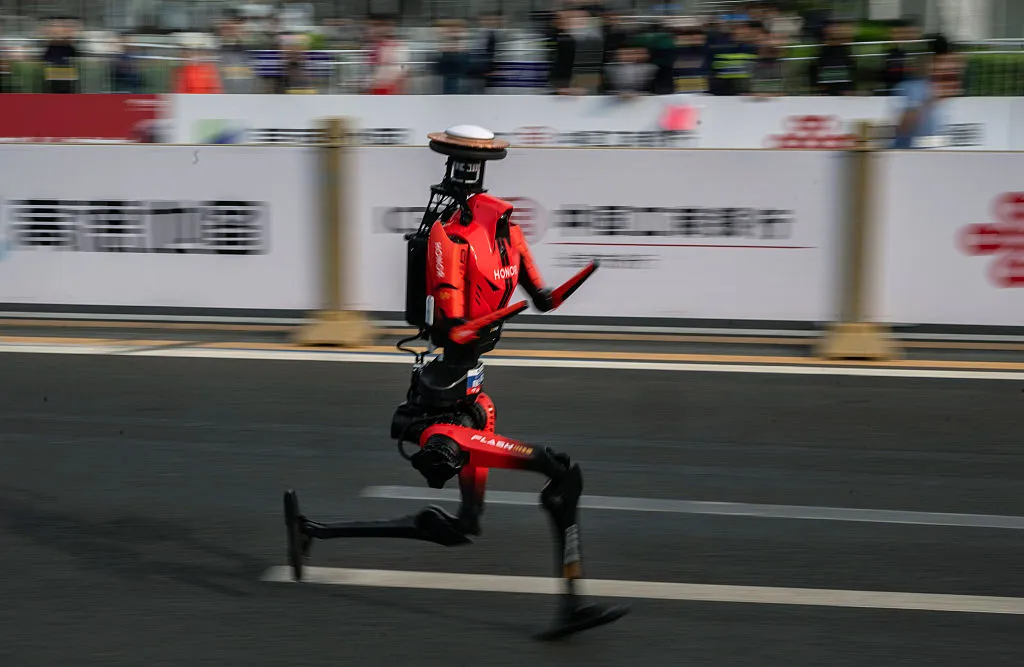
At the Beijing half-marathon, about 40% of the robots competed independently, while the rest were controlled remotely, event organizers said. Some robots struggled—one fell at the starting line, and another hit a barrier. Even with these problems, the event showed major progress in how humanoid robots move and last over long distances.
People on social media have questioned whether it is fair to compare human runners with machines. As one user put it, “My car can outrun a cheetah, too,” pointing out that machines usually have some advantages over living things. Still, the jump from a 160-minute finish to just 50 minutes shows that robots are making fast progress in stability, energy efficiency, and real-time path planning.
Beijing’s E-Town tech hub, now a leading robotics hub in China, hosted the event. The Associated Press reported that Honor’s robots stood out in the competition, but details about their motors, batteries, and control systems have not been shared.
In conclusion, robots have clearly surpassed human half-marathon records at the Beijing event. An autonomous Honor robot finished in just over 50 minutes, which is 110 minutes faster than last year’s winning time. This shows how quickly humanoid endurance and stability are improving.