


Pinterest CEO Bill Ready has gone on record calling for a global ban on social media for anyone under 16, and he’s doing so in one of the most public ways possible. In a recent article published in Time magazine, the Pinterest CEO said that technology platforms have failed young users and that government regulation—not industry self-policing—is now the only real path forward. The statement puts Ready in rare company among Silicon Valley executives, most of whom have denied calls for such sweeping restrictions.
What makes the Pinterest CEO’s position especially unique is the clear carve-out for his platform. Teens under 16 can still access Pinterest despite Australia’s current social media ban, which Ready uses as a model for other nations. That’s because Pinterest structured its platform differently: accounts for users under 16 are private by default, blocked from strangers, and stripped of the feed-driven social features that regulators and researchers have flagged as harmful. Whether that distinction holds up to public scrutiny is another matter.
What the CEO of Pinterest is really saying and why he’s speaking out
Ready published his argument first as a LinkedIn essay before it appeared in Time. His core message was direct: kids today are growing up inside what he called “the largest social experiment in history,” handed unrestricted access to platforms that were never designed with their safety in mind. According to TechCrunch, Ready wrote that the companies building these platforms gave “insufficient forethought about the consequences,” including exposing children to adult strangers and fueling screen addiction.

The Pinterest CEO drew a sharp comparison to the tobacco and alcohol industries. Both faced years of denial before regulation forced them to change—and Ready suggested that without similar action, social media companies will keep repeating the same cycle. His exact framing was pointed: tech CEOs who resist accountability sound like “20th-century tobacco executives who had to be shamed and sued into submission.”
The data cited by Ready is difficult to dismiss. According to U.S. News & World Report, the Centers for Disease Control and Prevention found that 57% of U.S. teen girls experienced persistent feelings of sadness or hopelessness—a sharp rise over the past decade. Pew Research Center data shows that roughly 95% of teens use social platforms, with about a third saying they are online “almost constantly.” Ready argues that engagement-driven platforms are structurally designed to keep kids hooked, not to keep them healthy.
On the policy side, the Pinterest CEO pointed to Australia as proof that a ban is workable. He also praised the U.S. approach of pushing for age verification in app stores, a framework that allows parents to control it. Countries including Malaysia, Spain, Indonesia, and France have either enacted or announced similar restrictions, and Germany’s ruling party has expressed support for limits on youth social media use. According to Reuters, French lawmakers recently approved a ban on social media for users under 15, putting meaningful legislative action squarely on the table.
There’s no doubt that Pinterest’s CEO’s platform is unique.
There’s an obvious tension in the Pinterest CEO’s stance: he’s calling for a broad ban while his platform remains accessible to minors in Australia’s regulatory framework. Ready addresses the issue directly—and the distinction matters. Pinterest isn’t structured like Instagram, TikTok, or Snapchat. It functions more as a visual search and inspiration tool than a social network. For users under 16, the platform has already removed the social elements most tied to harm:
- Accounts are private by default and not discoverable by strangers
- Unsolicited messages, comments, and external likes are blocked
- Users are protected from contact with adult strangers
- No engagement-driven feed optimized for maximum screen time
- The minimum sign-up age in the U.S. is 13, in line with federal law
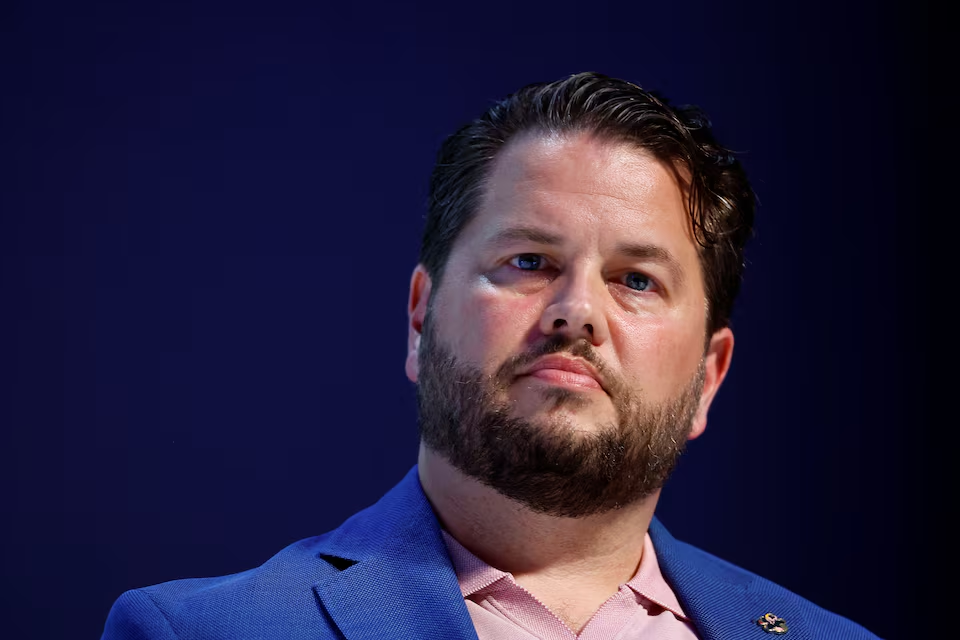
The Pinterest CEO says these changes didn’t hurt the platform’s appeal to younger users—in fact, the opposite happened. According to the company, Gen Z now makes up more than 50% of Pinterest’s total user base, which Ready cites as evidence that safer defaults build trust rather than push teens away. A third of Pinterest’s users are between 17 and 25, according to Apptopia, a research firm.
Critics of the broader ban argue that teens will find workarounds or migrate to less regulated platforms—and that social media, when used well, offers real community and connection. Others question whether age verification can be implemented without creating new privacy risks. Policy experts increasingly favor a layered approach: device-level parental controls, platform-based age checks with third-party certification, and tight limits on how data can be retained or reused.
But the Pinterest CEO’s broader argument is about incentives. Ad-supported platforms are built to maximize Time spent—not to protect mental health. As long as engagement is the metric that matters most, Ready believes the risks to children will remain. Government intervention, he says, is how you change the incentive structure.
In conclusion, the Pinterest CEO is making a calculated and consequential argument. Bill Ready is betting that positioning Pinterest as the responsible platform—while pushing for regulation that would limit its bigger rivals—is both ethically sound and commercially smart. Whether other governments follow Australia’s lead remains to be seen. But the Pinterest CEO’s public stance signals that at least one tech executive is willing to say what most won’t: the industry had its chance, and it fell short.