

OpenAI has launched GPT-5.5, its latest and most user-friendly language model, for paying subscribers. This update brings better context understanding, quicker responses, and improved performance in coding, research, and data analysis. 9to5Google reports that ChatGPT Plus, Pro, Business, and Enterprise users can already use the new model. There is also a more advanced ‘Pro’ version, but it is only available to higher-tier subscribers.
This release is an important move for OpenAI as it works to create more independent AI assistants. GPT-5.5 does not need users to give perfectly worded prompts. Instead, it can handle unclear, multi-step requests and finish them with less guidance. According to OpenAI, the model is good at tracking context in complex systems, identifying problems even when they are not obvious, and using tools to review its own work.
How OpenAI’s GPT‑5.5 improves on previous models?
The headline improvement in GPT‑5.5 is contextual understanding. OpenAI has tuned the model to parse “messy” business requests and turn them into actionable plans without losing time or accuracy. In practical terms, users can give the model a loosely defined goal—such as debugging a sprawling codebase or preparing a report from scattered data—and trust it to plan the steps, use the right tools, and keep going until the job is done.
According to OpenAI’s official announcement, early testers found that GPT‑5.5 shows a stronger ability to understand why a system is failing and where a fix needs to land. The model also carries changes through a surrounding codebase more reliably than its predecessor, GPT‑5.4.
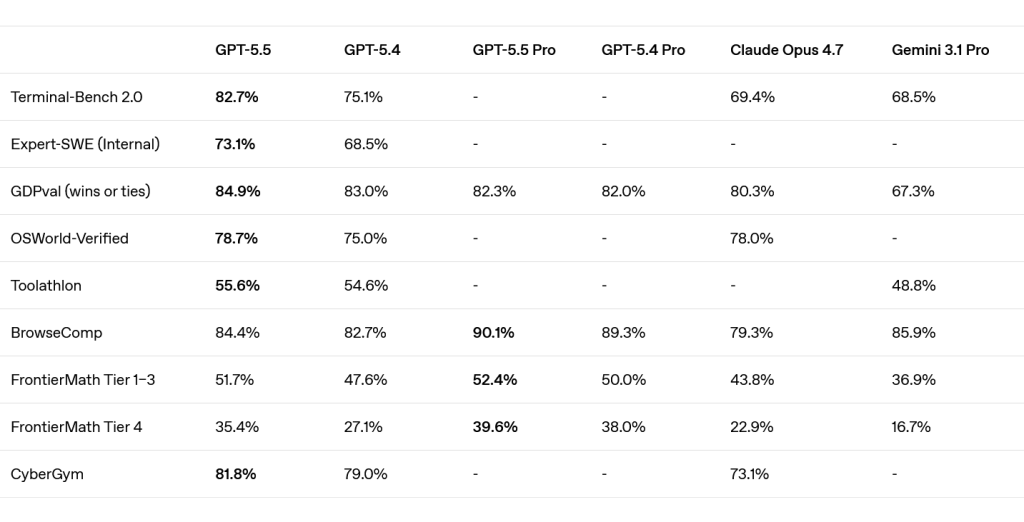
OpenAI’s newest benchmarks reveal that GPT-5.5 performs better than both its previous version and other models. In the Terminal-Bench 2.0 coding test, GPT-5.5 scored 82.7%, GPT-5.4 scored 75.1%, and Claude Opus 4.7 scored 69.4%. On the BrowseComp web-browsing test, GPT-5.5 reached 84.4%, while Claude Opus 4.7 scored 79.3%.
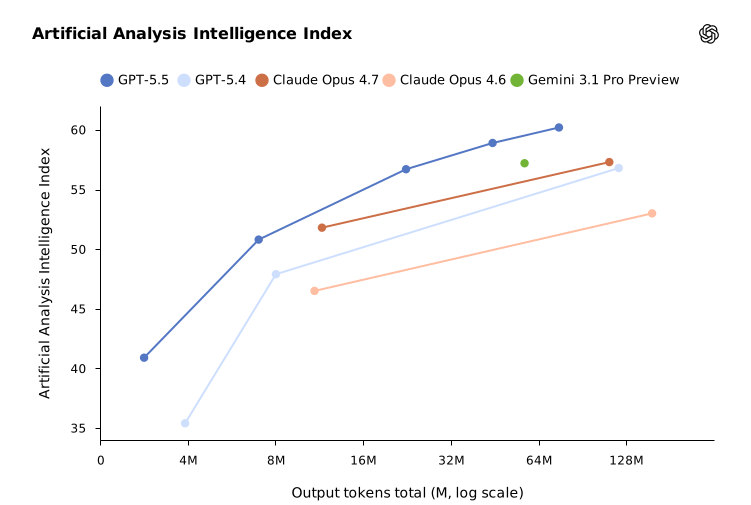
Perhaps most notable for everyday users, GPT‑5.5 achieves these higher scores without becoming slower. OpenAI reports that per‑token latency matches that of GPT‑5.4. In some coding workflows, the new model uses significantly fewer tokens to complete the same tasks—making it both faster and more cost‑effective to run.
Who gets access to GPT‑5.5?
OpenAI is making GPT‑5.5 available to paid subscribers starting April 23, 2026. The rollout covers:
- ChatGPT Plus subscribers ($20 per month)
- Pro, Business, and Enterprise subscribers
- Users of Codex, OpenAI’s coding assistant
GPT-5.5 Pro, a higher-performance version, is only available to Pro, Business, and Enterprise users. Free users cannot access GPT-5.5. API access is not available yet. OpenAI is working with partners to meet safety and security requirements before launching the model through the API. Once available, API pricing will be $5 per million input tokens and $30 per million output tokens, with a 1-million-token context window. GPT-5.5 Pro will cost $30 per million input tokens and $180 per million output tokens.
OpenAI says GPT-5.5 is its most carefully safety-tested model so far. The company used its full preparedness framework, brought in both internal and external red-team testers, and ran focused tests on advanced cybersecurity and biological risks. Almost 200 early-access partners also provided feedback on real-world use cases before the public launch.

In a statement accompanying the release, OpenAI co‑founder and president Greg Brockman said the model is faster and more precise than GPT‑5.4 while using fewer tokens, reflecting the company’s goal of making advanced AI more accessible to businesses and everyday users alike.
In conclusion, OpenAI has launched GPT-5.5, a new AI tool built to handle complex tasks more independently. It offers a better understanding of context, stronger coding skills, and greater efficiency without slowing down. GPT-5.5 is aimed at professionals who want help managing complicated, multi-step work with little supervision.