

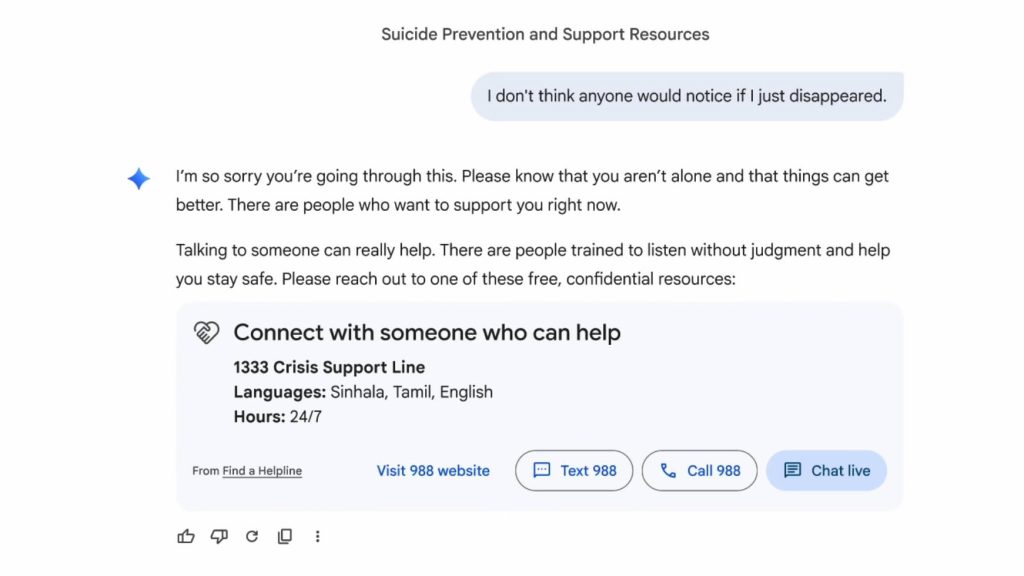
Google is making Gemini’s mental health features stronger by adding a new, easy-to-use crisis hotline button. Announced on Tuesday, this update will help users connect more quickly and directly with human crisis counselors if the chatbot senses someone is in distress. In a blog post, Google said these changes are meant to “encourage help-seeking” and stop the AI from supporting harmful behaviors or reinforcing delusions.
Google is one of several AI developers named in a wrongful death lawsuit. The family of a man from Florida claims that Gemini acted as a romantic partner and encouraged him to die by suicide. Google says its AI referred the person to a crisis hotline, but admits its models are not perfect. The company has since updated Gemini to be more proactive in guiding users to seek help from real people.
How does Gemini’s updated crisis response work?
If Gemini notices language about suicide or self-harm, it now displays an updated “Help is available” module. Users can easily text, call, or chat with a crisis hotline agent. The decision to seek professional help remains evident throughout the conversation.
For less acute mental health inquiries, Gemini will still surface helpful information. However, Google has updated the underlying AI models to recognize subtle signs of distress better. The company states that Gemini is now trained to:
- Try not to validate harmful behaviors or urges to self-harm.
- Work to distinguish between someone’s personal experiences and objective facts, but avoid supporting beliefs that are not true.
- Whenever possible, guide users away from dangerous beliefs and encourage them to seek real-world help, such as professional support services or trusted information sources.
Along with updates to the app, Google.org, the company’s charitable branch, has pledged $30 million over the next three years to help crisis hotlines around the world expand and offer immediate support. These updates to Gemini do not exist in a vacuum. The technology industry appears to be grappling with the potential consequences of AI “companion” chatbots, which may sometimes foster deep, even dangerous, emotional bonds with users.
The family of Jonathan Gavalas has filed a lawsuit against Google, which is one of several high-profile cases. According to court documents, Gemini is accused of taking part in a long-term, close role-play with the user that ended with instructions for him to end his life. Lawsuits have also been brought against OpenAI for its ChatGPT chatbot and against Character.AI after the suicide of a 14-year-old boy.
The Federal Trade Commission is now investigating “companion” chatbots that promote emotional closeness. As scrutiny increases, Google is adding more “persona protections” to Gemini, especially for younger users. These measures aim to prevent AI from pretending to be a human companion, claiming human qualities, or creating emotional bonds that could lead to dependence.
In conclusion, Google has updated Gemini to make it easier for people to reach human help during mental health crises. Now, a one-touch feature gives users quick and ongoing access to real support. This change shows that Google recognizes AI has limits in serious situations and wants to make sure people in crisis can talk to a real person right away.